Eco-Friendly Commercial Window Cleaning Services in Dallas, TX
Green commercial window cleaning services for environmentally conscious Dallas businesses. We use biodegradable, non-toxic cleaning solutions that deliver exceptional results while protecting the environment.
Service Overview
Eco-friendly commercial window cleaning provides the crystal-clear results businesses require while protecting environmental and human health. This green approach utilizes biodegradable cleaning solutions, water-conserving techniques, and sustainable practices that minimize ecological impact without compromising quality. For Dallas businesses committed to environmental responsibility, our eco-friendly services align corporate values with facility maintenance.
Traditional window cleaning often relies on harsh chemicals that introduce toxins to the environment and create health concerns for building occupants. Eco-friendly alternatives utilize plant-based surfactants, purified water systems, and biodegradable formulas that achieve superior results without these negative impacts. Our green window cleaning services prove that environmental responsibility and exceptional quality go hand in hand.
Dallas businesses increasingly prioritize sustainability in their operations and vendor relationships. Green building certifications, corporate sustainability goals, and customer expectations all drive demand for environmentally responsible services. Our eco-friendly window cleaning helps businesses meet these objectives while maintaining the professional appearances their success requires.
Our Process
Green Solution Selection
We select biodegradable cleaning agents appropriate for your specific window types and contamination.
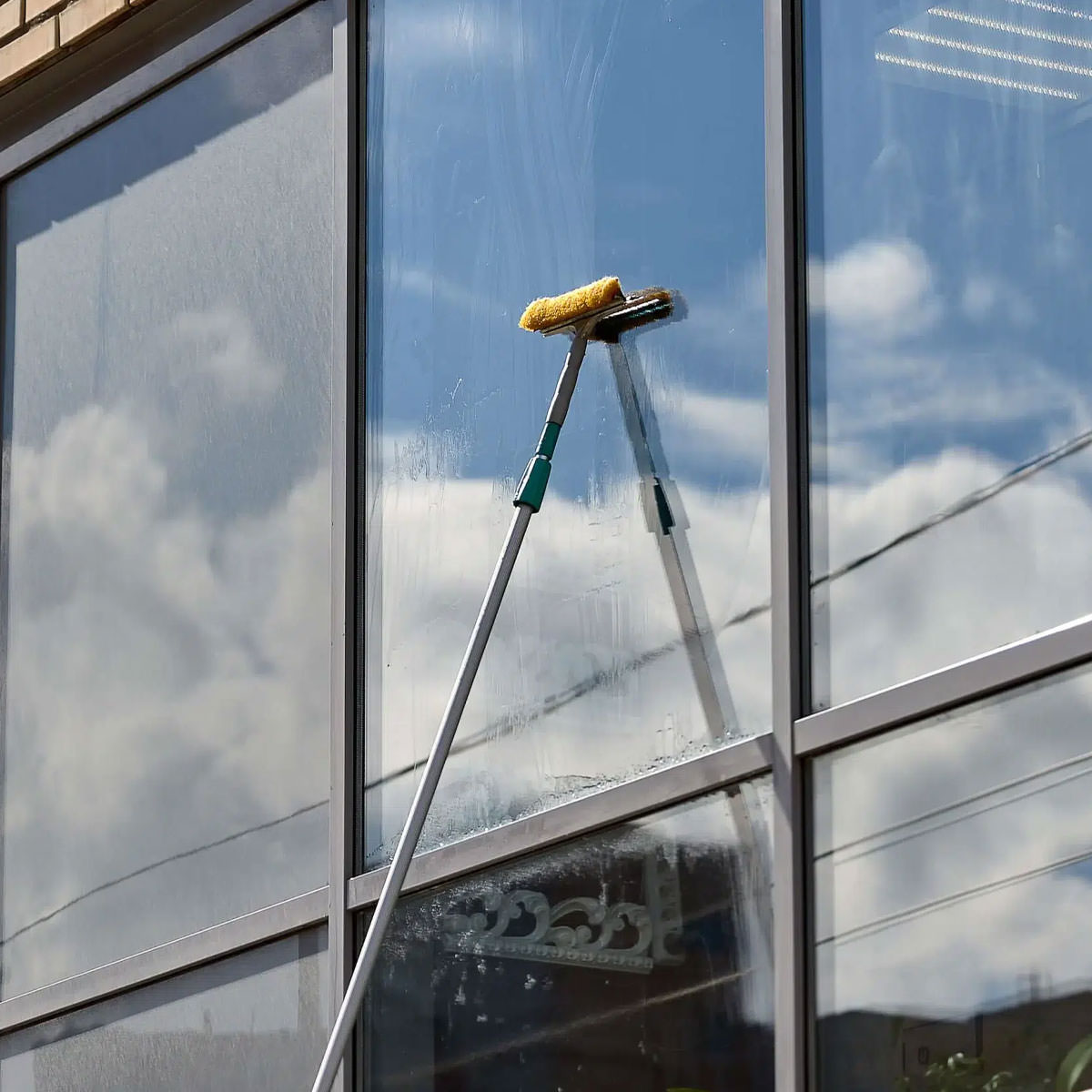
Water-Fed Pole Application
Pure water systems minimize chemical use while delivering streak-free results.
Responsible Waste Management
All wastewater and materials are managed according to environmental best practices.
Sustainable Results
Longer-lasting cleanliness reduces service frequency and environmental impact.
Green Cleaning for Dallas Businesses
Environmental responsibility has become a core value for Dallas businesses across all industries. Customers, employees, and stakeholders expect companies to minimize their ecological footprint while maintaining quality operations. Our eco-friendly window cleaning services allow businesses to meet these expectations without sacrificing the professional appearances that drive success.
Our green cleaning approach utilizes plant-based solutions that biodegrade quickly without harming soil, water, or wildlife. We avoid phosphates, ammonia, and volatile organic compounds that create health hazards and environmental damage. Pure water technology reduces water consumption while delivering superior cleaning results. For Dallas businesses pursuing sustainability, our services demonstrate commitment to environmental values through concrete action.
Safe for People and Property
Traditional window cleaning chemicals can create health concerns for building occupants, particularly those with allergies, asthma, or chemical sensitivities. Fumes from harsh cleaners irritate eyes and respiratory systems, while residues on glass surfaces contact skin during normal use. Our eco-friendly solutions eliminate these concerns with formulas safe for human contact and indoor air quality.
Our green cleaning methods also protect landscaping, exterior finishes, and surrounding environment. Biodegradable solutions won't harm plants or grass if runoff occurs. Gentle cleaning techniques preserve window seals and frames that harsh chemicals can degrade over time. Dallas property managers appreciate services that protect both their buildings and the people who occupy them.
Supporting Your Sustainability Goals
Whether your Dallas business pursues LEED certification, reports to sustainability frameworks, or simply operates according to environmental values, our eco-friendly window cleaning supports those objectives. We provide documentation of green practices for certification requirements and corporate reporting. Our services count toward sustainability metrics that increasingly influence customer and investor relationships.
Many Dallas businesses find that eco-friendly services attract environmentally conscious customers and employees who share their values. Green window cleaning becomes part of a broader sustainability story that differentiates your business in competitive markets. Our services help you walk the talk on environmental responsibility, demonstrating authentic commitment through vendor selection and operational choices.
Key Benefits
- Biodegradable, non-toxic cleaning solutions
- Reduced water usage through pure water systems
- Safe for employees, customers, and wildlife
- Supports green building certifications
- No compromise on cleaning quality
Serving All of Dallas-Fort Worth
We provide eco-friendly commercial window cleaning throughout the Dallas metroplex. View our service areas or contact us for availability in your location.
services planning guide
How to plan eco friendly commercial window cleaning for a commercial property in Dallas
Dallas Commercial Window Cleaners uses the following planning framework to help property managers and business owners turn a request for commercial window and exterior-glass cleaning into a scope that can be walked, priced, scheduled, and checked. It is designed for practical comparison and does not replace site-specific safety, material, vendor, or regulatory requirements.
Define the Work Before Pricing It
A walkthrough for eco friendly commercial window cleaning is most productive when the decision-maker identifies the spaces that create complaints, the areas that carry the most traffic, and the tasks the current program misses. Those observations turn a generic checklist into a practical scope tied to the way the property is actually used. A commercial scope should distinguish appearance cleaning from hygiene work and asset maintenance. Dust removal, disinfection, floor finish care, glass restoration, and debris control solve different problems, use different processes, and often belong on different frequencies. The strongest eco friendly commercial window cleaning plan names measurable outcomes rather than relying on broad phrases such as “keep it clean.” Examples include streak-free entry glass, stocked and odor-controlled restrooms, debris-free floor edges, sanitized touchpoints, and completion before a stated opening time. Square footage alone does not define the effort required for eco friendly commercial window cleaning. Occupancy, floor materials, restroom count, food or production activity, security procedures, furniture density, and the time available between closing and reopening all affect labor and equipment planning.
Build the Schedule Around Operations
Access planning is part of service planning. Keys, badges, alarm procedures, loading access, elevator reservations, escort rules, and locked-room approvals should be confirmed before the first eco friendly commercial window cleaning visit so the crew can complete the full scope without improvising. For Dallas–Fort Worth properties, travel windows and building access can materially affect the usable service period. A realistic schedule accounts for security handoffs and operating deadlines rather than promising a start time that leaves too little time to finish. Scheduling should be built around operating hours and risk, not around the cleaning company’s convenience. Some commercial property environments need a complete after-hours reset, while others benefit from daytime attention to entrances, restrooms, spills, or high-traffic common areas. A nightly, daily, weekly, or project schedule changes more than visit frequency. It changes how much soil accumulates between visits, which tools are appropriate, how long each visit takes, and whether periodic deep work must be layered into the agreement.
Make Quality Control Observable
Consistent crew assignments improve eco friendly commercial window cleaning because the team learns access routines, material sensitivities, recurring problem areas, and the expectations of the facility contact. Coverage plans are still necessary for absences so consistency does not depend on one individual. The account review should examine service requests, inspection findings, occupancy changes, supply use, and upcoming facility events. That review keeps the program aligned with the property instead of allowing an old scope to continue after the building changes. Before-and-after documentation is especially valuable for one-time or restorative eco friendly commercial window cleaning. It establishes the starting condition, records the completed result, and helps the facility manager decide whether a recurring maintenance cycle would prevent the same buildup. A quality program should explain how corrections are handled. The facility contact needs a clear response path, a reasonable correction window, and confirmation when the issue is closed rather than a vague assurance that someone will look into it.
Match Methods to Materials and Risk
Equipment should be selected for the facility rather than for convenience. HEPA filtration, low-moisture extraction, auto-scrubbing, water-fed poles, pressure equipment, or detail tools may be appropriate depending on access, surface, soil, and reopening time. Product selection should match the task and the occupied environment. Cleaning, degreasing, disinfecting, descaling, and finishing are different functions; using one product for every surface can leave residue, reduce effectiveness, or shorten asset life. Color-coded cloths, pads, and tools can reduce cross-use between restrooms, food areas, workspaces, and public surfaces. The exact system matters less than having a documented method the crew can follow consistently. Surface identification matters because a process that works on one material can damage another. Before eco friendly commercial window cleaning, confirm flooring, stone, coated metal, glass treatments, upholstery, painted surfaces, and manufacturer restrictions that affect chemistry or agitation.
Use the Walkthrough to Build the Scope
For larger properties, divide the walkthrough into zones and record the floor type, use, occupancy, and desired frequency for each. This produces a proposal that can be adjusted by zone without rewriting the entire program. Ask department leads or regular occupants where cleaning failures are most visible. Facility managers often know the formal complaints, while daily users can identify recurring issues such as neglected corners, supply shortages, or timing conflicts. Discuss current service honestly during the walkthrough. What works should be preserved, what fails should be corrected, and any unrealistic expectation should be resolved before it becomes a recurring dispute after startup. Bring a current floor plan, operating schedule, and list of known problem areas to the walkthrough. These details help Dallas Commercial Window Cleaners organize eco friendly commercial window cleaning around actual conditions instead of estimating from square footage and a short phone description.
Put the Service Agreement in Writing
Service-level expectations should be realistic and observable. A promise of “perfect cleaning” is less useful than response times, inspection routines, named completion outcomes, and an escalation process for repeated deficiencies. The agreement should explain how additional work is approved. Emergency cleanup, event service, construction dust, floor restoration, and extra porter coverage should not be performed or billed through an informal request that no one can later verify. A structured startup period gives both sides a chance to refine the scope. Early inspections and a scheduled review after the first few visits can resolve workload assumptions before they become embedded in a long-term program. Cancellation, renewal, and notice terms deserve the same attention as the cleaning checklist. A facility manager comparing proposals should understand the initial term, renewal method, price-review process, and the notice required to change or end service.
Plan for Dallas Facility Conditions
DFW traffic makes realistic arrival windows important, especially when a crew must meet security or elevator access at a fixed time. The plan should protect enough on-site time to complete the work rather than compressing the scope after a delayed handoff. Heat and air-conditioning runtime can increase dust movement through vents, ledges, high surfaces, and return-air zones. Periodic detail work should be scheduled before accumulation becomes visible or begins cycling back into occupied areas. Fast regional growth creates frequent move-ins, renovations, tenant turnovers, and occupancy changes. The cleaning scope should be reviewed when a property changes use instead of assuming the previous tenant’s schedule remains appropriate. Dallas facilities contend with long cooling seasons, tracked-in dust, pollen, severe-weather debris, and rapid development activity. Those conditions can influence entry cleaning, high dusting, floor care, glass maintenance, and the timing of periodic deep work.
Compare Providers on More Than Price
Ask each provider to explain staffing assumptions, visit length, supervision, equipment, and the process for covering absences. The answer reveals whether the proposal is an operating plan or simply a price attached to a task list. Consider the cost of under-scoping. Persistent complaints, damaged finishes, emergency restoration, staff time spent supervising the vendor, and repeated provider changes can cost more than a properly designed recurring program. References are most useful when the compared account resembles the property in size, use, and schedule. A successful small office account does not by itself demonstrate the systems needed for a large, high-traffic, or specialized facility. The final decision should align service frequency with the facility’s real use. Buying fewer visits than the property needs creates visible decline; buying unnecessary frequency wastes budget that could be directed to periodic or high-priority work.
Start, Measure, and Adjust the Program
The first visit should not be treated as an ordinary maintenance visit when buildup already exists. Startup cleaning establishes a maintainable baseline and gives the crew a realistic view of the time required for future service. The crew should record conditions outside the approved scope rather than quietly ignoring them or performing unapproved work. Photos and concise notes allow the facility manager to decide whether a separate service is warranted. Crew orientation should cover the approved scope, building access, material cautions, waste handling, supply storage, security, and the communication path for exceptions. Written information is more dependable than verbal instructions passed between shifts. After the first service cycle, compare actual labor and facility condition with the proposal assumptions. If the original scope was inaccurate, adjust it openly rather than expecting quality to survive an unrealistic workload.
Bring to the walkthrough
- Approximate square footage, floor plan, and operating hours
- Current frequency, known complaints, and priority areas
- Flooring and surface notes, restricted rooms, and access rules
- Desired start date, budget constraints, and approval contacts
Expect in a written proposal
- Task scope by zone and visit frequency
- Service windows, periodic work, and supply responsibility
- Quality checks, communication, and correction procedures
- Pricing assumptions, exclusions, and change-order rules